Devanahalli vs Electronic City 2026 — Which Is Better to Buy?
Published 26 Jun 2026 · Last updated 26 Jun 2026

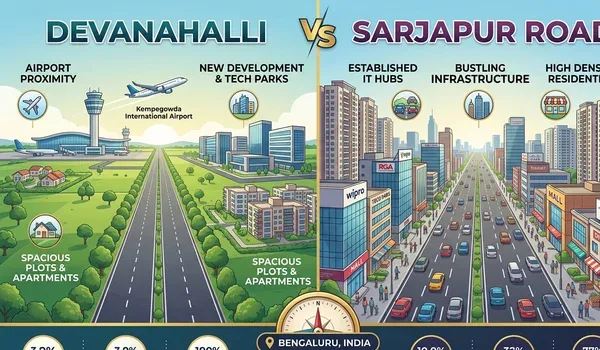
Devanahalli in North Bengaluru and Electronic City in the south are two of the city's most-discussed places to buy a home, and they sit at opposite ends of the map for a reason. One grew around Kempegowda International Airport and the aerospace belt; the other grew around the IT industry that put Bengaluru on the global tech map. This 2026 comparison weighs them on jobs, prices, connectivity, rental demand and growth, so you can match the location to your own life rather than to a headline.
The honest short answer is that there is no single winner. The better buy depends mostly on where you work and how long you plan to hold. Below, we lay out the differences factor by factor, keep the prices indicative, and finish with a balanced verdict that should help you decide between the two corridors.
Devanahalli vs Electronic City — Factor Comparison
| Factor | Devanahalli (North) | Electronic City (South) |
|---|---|---|
| Main job base | Airport, KIADB Aerospace Park & SEZ, aviation, hospitality | IT & ITES belt — Infosys, Wipro, tech & manufacturing firms |
| Indicative price | ~₹8,200–9,500/sq ft (new launch) | On request / indicative, varies by phase & age |
| Key roads | NH-44 (Bellary Road), airport access, ORR link | Hosur Road, Elevated Expressway |
| Metro | Blue Line under construction (confirm with BMRCL) | Connected via its own line |
| Rental demand | Growing — airport, aerospace, hospitality staff | Established — large IT workforce |
| Stage of growth | Earlier-stage, airport-led expansion | Mature, proven IT hub |
| Density | Lower, newer, more open land | Higher, denser, built-up |
Prices above are indicative only and move with each project, phase and possession stage. Treat the table as a starting frame, then verify the latest numbers for any specific home you shortlist.
1. Jobs and Employment Base
Jobs are the single biggest reason most buyers pick one of these corridors over the other, because the daily commute shapes the rest of life. The two areas draw on very different economies.
Electronic City is one of India's oldest and largest IT clusters. Its Phase 1 and Phase 2 zones house major employers, with Infosys and Wipro campuses anchoring a deep base of software, services and some manufacturing firms. For anyone working in that ecosystem, living nearby can turn a punishing cross-city drive into a short hop.
Devanahalli's job story is newer and built around infrastructure rather than software parks. It is shaped by Kempegowda International Airport, the KIADB Aerospace Park and SEZ, aviation and logistics firms, hotels, and the planned Bengaluru Airport City business district. The base is smaller today but is widening as the airport region matures.
- Electronic City: large, established IT & ITES workforce already in place.
- Devanahalli: airport, aerospace and hospitality jobs, with a longer growth runway.
- Commute test: map your actual office before anything else — this factor alone often decides the buy.
Bottom line: if your work is in the South Bengaluru tech belt, Electronic City wins on jobs today; if it is airport, aviation or aerospace linked, Devanahalli is the natural base.
2. Property Prices
Both corridors are relatively affordable next to central Bengaluru, which is part of why each draws first-time buyers and investors. The pricing logic, though, is different.
Devanahalli new launches sit at roughly ₹8,200–9,500 per sq ft, with smaller homes such as a 1 BHK starting around ₹61.75 L and base rates near ₹9,500 per sq ft on newer projects; ready and township stock in the wider belt can run higher. Electronic City pricing is best treated as on request and indicative, because it spans newer towers, older resale apartments and a wide range across Phase 1, Phase 2 and the fringe villages, so a single number would mislead.
- Devanahalli: mostly new-launch pricing on fresh inventory, with entry options at smaller sizes.
- Electronic City: a broad mix of new, resale and older stock — range varies widely by phase and age.
- Like-for-like: compare the same configuration, age and possession stage, not just a headline per-sq-ft figure.
Bottom line: entry budgets can be similar, but Devanahalli leans newer and Electronic City offers more resale choice; price any home individually before you compare.
3. Connectivity and Roads
Connectivity is where the two corridors point in literally opposite directions, and that matters for both commute and resale.
Devanahalli runs along NH-44 (Bellary Road) with direct access to the airport, an Outer Ring Road link towards the rest of the city, and a metro Blue Line that is under construction — confirm the latest timeline with BMRCL rather than relying on a fixed date. Electronic City is served by Hosur Road and its Elevated Expressway, which speed the run towards South Bengaluru and on to Hosur, plus its own metro connection that has improved access in recent years.
- Devanahalli: strongest for airport, North Bengaluru and outbound NH-44 travel.
- Electronic City: strongest for South Bengaluru, Hosur Road and the Tamil Nadu border belt.
- Reality check: both face peak-hour congestion — test your own route at the times you will actually travel.
Bottom line: each location connects you well to a different half of the city, so connectivity favours whichever side your work, family and travel sit on.
4. Rental Demand
If you are buying to let, the depth and source of tenant demand matters as much as the headline yield.
Electronic City has deep, established rental demand from a large and steady IT workforce, which keeps occupancy reliable and tenant turnover manageable across many price points. Devanahalli's rental demand is younger and led by airport staff, aviation and aerospace employees, and hospitality workers; it is growing and is expected to broaden as the airport business district and aerospace park fill out, but it does not yet have the same volume.
- Electronic City: mature tenant pool, proven occupancy, wide rent band.
- Devanahalli: emerging demand tied to airport and aerospace employment, with upside as the area matures.
- Yields: rental yields in both areas are indicative only — verify current rents with local agents.
Bottom line: Electronic City is the safer pick for immediate, dependable rental demand, while Devanahalli is the bet on a demand pool that is still building.
5. Growth and Future Outlook
The two corridors sit at different points in their life cycle, and that shapes both the risk and the potential reward.
Electronic City is a mature hub. Most of its core infrastructure is built, demand is proven, and growth from here tends to be steady rather than dramatic. Devanahalli is an earlier-stage story driven by the airport, the aerospace SEZ, planned business districts and large tracts of developable land, which can mean stronger appreciation potential over a longer horizon — though earlier-stage areas also carry more timing risk.
- Electronic City: mature, proven, steadier — lower surprise in either direction.
- Devanahalli: earlier-stage, infrastructure-led, more upside but a longer wait.
- Horizon: match the choice to your hold period and risk appetite, and consult a financial advisor.
Bottom line: choose Electronic City for proven stability and Devanahalli for longer-term, airport-driven growth potential.
6. Lifestyle and Social Infrastructure
Day-to-day living differs too. Electronic City is denser and more built-up, with established malls, hospitals, schools and a busy urban feel that suits buyers who want everything close at hand now. Devanahalli is lower-density and newer, pairing a quieter airport-suburb character with growing social infrastructure, international schools in the Yelahanka belt and the convenience of living near the airport.
Electronic City itself is documented on its Wikipedia page, which sets out its history as a planned IT hub. Devanahalli, by contrast, reads as a corridor still being shaped, with a new launch by Prestige Group such as Prestige Devanahalli at Poojanahalli adding to the residential options near the airport.
Bottom line: Electronic City offers an established, ready-now urban setting, while Devanahalli offers a quieter, newer suburb that is still filling in around you.
Which Should You Buy in 2026?
The decision comes down to a few simple questions. Where is your job, and is it likely to stay there? How long will you hold? Do you want a ready, established neighbourhood today, or are you comfortable buying into an area that is still growing?
If you work in the South Bengaluru IT belt, value a deep rental pool, and want established social infrastructure, Electronic City is the practical choice. If your work or interest is airport, aerospace or hospitality linked, you want newer low-density stock, and you are buying for the longer term, Devanahalli makes more sense. For a buyer weighing the airport corridor, you can review the Prestige Devanahalli price list and the floor plans to see how the budget and layouts compare. Whichever side you lean towards, if you buy a pre-launch home, confirm its registration on the K-RERA portal before you commit.
Frequently Asked Questions
1. Is Devanahalli or Electronic City better to buy in 2026?
Neither is better for everyone; it depends on where you work. Electronic City suits buyers tied to the South Bengaluru IT belt around Infosys and Wipro, while Devanahalli suits those linked to the airport, the KIADB Aerospace Park and SEZ, or buyers wanting a newer, lower-density airport suburb with more room to grow.
2. Which is cheaper, Devanahalli or Electronic City?
Both are relatively affordable compared with central Bengaluru. Devanahalli new launches are around ₹8,200 to ₹9,500 per sq ft, while Electronic City pricing is indicative and on request, varying widely between Phase 1, Phase 2 and the older resale stock. Confirm current rates project by project.
3. Where are the jobs — Devanahalli or Electronic City?
Electronic City has the larger established IT job base, anchored by Infosys, Wipro and many tech and manufacturing firms. Devanahalli's job story is newer and airport-led, built around Kempegowda International Airport, the KIADB Aerospace Park and SEZ and the planned Bengaluru Airport City business district.
4. How is connectivity different between the two?
Devanahalli runs along NH-44 with direct airport access and an under-construction metro line — confirm details with BMRCL. Electronic City is served by Hosur Road and the Elevated Expressway towards South Bengaluru and Hosur, with its own metro connection. Each connects you well to a different side of the city.
5. Which has better rental demand?
Electronic City has deeper, more established rental demand from a large IT workforce. Devanahalli's rental demand is growing from airport staff, aviation and aerospace employees and hospitality workers, and is expected to broaden as the airport business district matures. Rental yields in both areas are indicative; verify with local agents.
6. Is Devanahalli a good long-term investment versus Electronic City?
Devanahalli is an earlier-stage, airport-driven growth story with more upcoming land and infrastructure, which can mean higher upside but a longer horizon. Electronic City is a mature IT hub with steadier, more proven demand. Match the choice to your time frame and risk appetite, and consult a financial advisor.
Conclusion
Devanahalli and Electronic City are not really rivals so much as answers to different questions. Electronic City is the mature, IT-anchored choice with proven jobs, deep rental demand and ready infrastructure. Devanahalli is the newer, airport-led choice with lower density, fresher inventory and a longer growth runway. The right pick depends on where you work, how long you will hold, and whether you want established convenience today or upside over time.
Shortlist on your commute first, then compare a like-for-like home on price, possession and connectivity in each area — and book a site visit before you decide, so the numbers meet the reality on the ground.
Prestige Devanahalli Blog