Apartment Possession & Handover Guide for Devanahalli 2026
Published 02 Jul 2026 · Last updated 02 Jul 2026

The day you take possession of a flat is the day years of waiting turn into a set of keys — but it is also the day a careful buyer does the most checking. On the Devanahalli corridor in North Bengaluru, where much of the inventory is new-build and off-plan, the gap between booking a home and actually receiving it can run into years, so it pays to know exactly what "possession" and "handover" involve before you sign the acceptance. This 2026 guide walks through the whole process: what the two terms mean, the certificates that must be in place, how to inspect the flat, the dues and documents to settle, your rights if the builder is late, and the housekeeping to complete once the keys are yours.
Treat everything below as general guidance rather than legal advice. The exact sequence, the documents and the charges vary by project and by builder, and the rules around occupancy and registration can change. Use this as a working checklist and confirm the specifics with your builder, a lawyer and, for money matters, a CA before you rely on any single point.
Possession & Handover at a Glance
The table below sets out the main stages of a typical apartment handover and what a buyer should focus on at each one. These are general pointers, not a script for any single project; your builder's process and your registered agreement always take precedence.
| Stage | What to Focus On (Indicative) |
|---|---|
| Possession offer | Builder issues a possession or intimation letter once the flat is ready and the OC is in place |
| Snagging inspection | Joint walk-through of the flat; list every defect in writing before you accept |
| Final payment | Clear the last instalment and agreed charges; get a written receipt for each |
| Document handover | Collect possession letter, OC copy, warranties and utility papers |
| Keys & acceptance | Sign the handover only after snags are agreed and documents are received |
| Post-handover | Utilities, Khata, and joining the owners' association |
Bottom line: handover is a sequence, not a single moment — inspect and settle each stage in order, and keep every letter, receipt and certificate you are given.
What Possession & Handover Actually Mean
Although the words are used interchangeably, possession and handover describe slightly different things. Possession is the legal and physical transfer of the flat from the builder to you: the builder formally offers the completed unit, usually through a possession letter, and once you accept and complete the final payment you take charge of the home. Handover is the practical process wrapped around that transfer — the joint inspection, the snag list, the handing over of keys, and the pack of documents and warranties you receive on the day.
The distinction matters because your obligations and rights are tied to specific milestones. The date the builder offers possession is the date that counts against the timeline committed in your agreement, and the acceptance you sign at handover is your confirmation that you have received the flat in the agreed condition. If you sign that acceptance before inspecting, you may weaken your position on defects, so the order in which these steps happen is worth understanding rather than rushing.
It also helps to separate an offer of possession from actually taking possession. A builder can issue a possession letter, but if the flat is not genuinely ready or the paperwork is incomplete, you are within your rights to raise that before accepting. Read your agreement for how it defines possession, what triggers the final payment, and what the builder must have in place before the offer is valid.
Bottom line: possession is the legal transfer and handover is the physical process around it — know which milestone you are at, and do not sign acceptance until the flat and the papers are genuinely ready.
Occupancy Certificate (OC), CC & Why They Matter
Two certificates sit at the centre of a clean handover. The Completion Certificate (CC) is the confirmation that the building has been constructed and is complete as per the sanctioned plan. The Occupancy Certificate (OC) goes a step further and certifies that the building is fit for occupation, having met the required standards for structure, safety, water, sanitation and the like. In practice the OC is the document a buyer should care about most, because occupying a flat that does not have one can create difficulties with utility connections, future resale and even loan sanction.
You should ask to see the OC at handover and keep a copy in your records. If the builder offers possession without it, treat that as a point to clarify in writing before you accept, because taking the keys does not cure a missing certificate. In large phased projects it is also worth confirming that the OC covers your specific block or tower and not merely an earlier phase.
| Certificate | What It Confirms |
|---|---|
| Completion Certificate (CC) | Construction is finished as per the sanctioned plan |
| Occupancy Certificate (OC) | The building is fit and legally cleared for occupation |
| Possession letter | The builder formally offers you the specific flat |
Because verifying certificates and approvals is part of a wider due-diligence habit, it sits naturally alongside the broader pre-purchase review in the things to check before buying an apartment guide, which covers approvals, titles and RERA registration in more depth. For anything you are unsure about on the OC or CC, have a lawyer confirm the position rather than relying on a verbal assurance.
Bottom line: insist on the OC before you occupy, keep copies of the OC and CC, and confirm the certificate covers your block — verify with a lawyer if in doubt.
The Snagging Checklist: Inspecting Your Flat
Snagging is the joint inspection you carry out before accepting the flat, where you record every defect for the builder to fix. The aim is simple: to make sure the home you are about to accept matches what was promised and works as it should. This is the one stage where taking your time genuinely pays off, because issues logged before acceptance are far easier to get rectified than complaints raised afterwards. Where you can, take a qualified inspector or an experienced friend along, and set aside enough time to check every room properly.
Work through the flat methodically and note each issue in writing on a snag list that both you and the builder's representative sign. Photograph the problems, agree a timeline for rectification, and keep a copy. A practical checklist covers the following:
- Walls and ceilings: look for cracks, uneven plaster, damp patches and paint finish.
- Electrical: test every switch, socket and light point, and check the distribution board and geyser.
- Plumbing: run all taps, showers and flushes; check drainage, water pressure and any leaks under sinks.
- Doors and windows: open and close each one, check locks, handles, seals and glass.
- Flooring and tiling: tap tiles for hollow sounds, look for chips, cracks and level.
- Fittings and area: confirm the promised fittings are installed and the flat area and layout match the agreement.
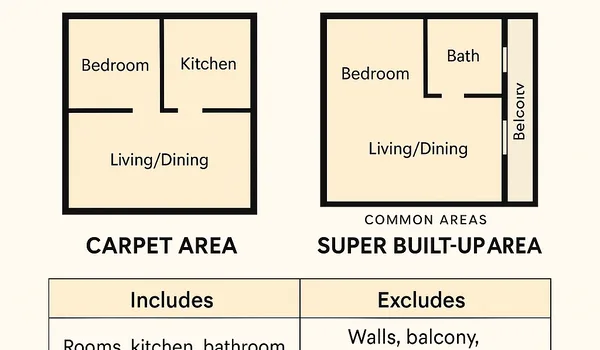
Understanding what area you are actually receiving is part of this check, since the usable space can differ from the figure on the brochure. If that distinction is new to you, the difference between carpet and super built-up area is worth reading before you inspect, so you can confirm the flat measures up to what you paid for.
Bottom line: inspect every room against a written, signed snag list before you accept, photograph each defect, and agree a rectification timeline with the builder.
Documents & Dues to Settle at Handover
Handover is also a financial and paperwork checkpoint. On or around the day you take possession, you typically clear the final instalment of the flat cost together with any agreed charges, and in return you should receive a defined set of documents. The important discipline is to know in advance exactly what the final demand includes, what is extra, and what you are getting for each payment, so there are no surprises at the counter.
On the money side, the final demand may include the last construction-linked instalment, and separately items such as advance maintenance, a corpus or sinking fund contribution, and deposits for utility meters and connections. Ask for a clear, itemised statement and a written receipt for each payment. How the ongoing society charges are structured is a subject in its own right, and the apartment maintenance charges guide explains the recurring costs you take on once you move in.
On the document side, the pack you collect at handover typically includes the following:
- Possession letter formally handing over the specific flat.
- Occupancy Certificate copy for your block or tower.
- Registered sale deed position and any conveyance documents.
- Warranty documents for fittings, waterproofing and equipment where provided.
- Payment receipts and a final no-dues acknowledgement.
For a pre-launch purchase this settlement lies in the future, but it still shapes how you budget today. When you plan the full cost of the home you can review indicative pricing on the price list and treat the final-payment-at-handover as the last major outflow, years after booking. Have a lawyer or a CA review the final statement and the documents before you pay.
Bottom line: settle the final dues against an itemised statement, collect the full document pack with receipts, and have a lawyer or CA review everything before you sign off.
If Possession Is Delayed: Your RERA Rights
Delays are the single most common grievance in the housing market, and this is where the law gives buyers real protection. Under the Real Estate (Regulation and Development) Act, a builder must hand over the flat by the date committed in the registered agreement. If possession is delayed beyond that date, you generally have the right either to withdraw from the project and seek a refund of the amount paid with interest, or to stay in the project and claim interest or compensation for the period of delay, as provided in the Act and your agreement. In Karnataka these matters are handled by K-RERA, and buying only into projects that are properly registered is the first line of protection.
To keep your position strong if a delay occurs, hold on to everything: the registered agreement, every payment receipt, and all written communication with the builder about timelines. Check the project's registered status and committed possession date rather than relying on marketing dates, and if a delay drags on, take legal advice on the specific remedy that fits your situation. The right choice between a refund and compensation depends on your finances and how far the project has progressed, so it is a decision worth making with a lawyer rather than in haste.
None of this replaces plain diligence at the outset. Confirming the committed date in writing, understanding the penalty clauses in your agreement, and knowing which authority you would approach all matter more than any assurance given verbally at booking.
Bottom line: RERA lets you seek a refund with interest or compensation for a delay — preserve your agreement and receipts, verify the registered status, and consult a lawyer on the right remedy.
After Handover: Utilities, Khata & the Association
Taking the keys is not quite the end of the process. Once the flat is yours, a short run of administrative tasks turns it into a home you can properly occupy and, later, sell without friction. The first of these is getting the utilities transferred and activated in your name — the electricity connection, water, piped gas if provided, and any deposits associated with them — so that billing runs against your account rather than the builder's.
Next comes the property record. Getting the flat entered in the municipal or panchayat records and the Khata updated in your name is what establishes you formally as the owner for tax and civic purposes, and it is the record buyers and banks look for later. The Khata and property documents guide sets out how this works on the Devanahalli belt and which body maintains the record for a given project. Alongside the Khata, register for property tax so the annual cycle begins cleanly in your name.
Finally, engage with the residents' or owners' association, which handles the common areas, security, water and the shared services once the builder hands the community over. Understand the maintenance model, the corpus, and the transition period during which the builder still manages the estate before the residents take charge. For a pre-launch home this whole phase lies years ahead, but the same steps will apply on the day you eventually move in.
Bottom line: after handover, transfer the utilities, get the Khata and property tax updated in your name, and join the owners' association — these steps make ownership clean and future resale simpler.
Frequently Asked Questions
1. What is the difference between possession and handover?
Possession is the point at which the builder formally offers you the completed flat and you take legal and physical charge of it, usually against a possession letter and after the final payment. Handover is the practical process around that moment - the joint inspection, the snagging list, the keys, and the pack of documents and warranties you receive. In everyday use the two words are often merged, but it helps to treat possession as the legal transfer and handover as the physical process that surrounds it. Confirm the exact sequence in your agreement and with your builder.
2. Is an Occupancy Certificate mandatory before I take possession?
You should insist on it. The Occupancy Certificate (OC) is the local authority's confirmation that the building is complete as per the sanctioned plan and is fit for occupation, and taking possession of a flat without an OC can create problems with utilities, resale and loans later. A Completion Certificate (CC) certifies that construction is finished, while the OC certifies it is fit to occupy. Ask to see the OC at handover, keep a copy, and confirm its status with a lawyer if you are unsure.
3. What should I inspect during snagging?
Snagging means walking the flat before you accept it and listing every defect for the builder to fix. Check walls and ceilings for cracks and damp, test every switch, socket, tap and flush, run the geyser, open and close all doors and windows, look for hollow or chipped tiles, and confirm the flat area and fittings match what was promised. Photograph each issue, record it on a signed snag list with the builder, and agree a timeline to rectify before you settle the final dues. When in doubt, take a qualified inspector along.
4. What dues and documents should I settle at handover?
At handover you typically clear the final instalment and any agreed charges, then collect the possession letter, a copy of the OC, the registered sale deed position, warranty documents for fittings, and any as-built or utility papers. Confirm what is included in the final demand and what is extra, such as advance maintenance, a corpus or sinking fund contribution, and meter or connection deposits. Get a written receipt for every payment, and have a lawyer or a CA review the final statement before you pay.
5. What are my RERA rights if possession is delayed?
Under RERA the builder must hand over by the date committed in the registered agreement, and if possession is delayed you generally have the right to either withdraw and seek a refund with interest, or continue and claim interest or compensation for the delay, as provided in the Act and your agreement. In Karnataka these matters are handled by K-RERA. Keep your agreement, payment receipts and all communication, check the registered project status, and consult a lawyer on the specific remedy available in your case.
6. When will possession happen for a pre-launch flat like Prestige Devanahalli?
For a pre-launch project, possession is years away, so a buyer today is committing now and taking handover much later. Prestige Devanahalli is a pre-launch project at Poojanahalli with possession indicated from Dec 2030 and its K-RERA application in process, which means the handover steps in this guide apply on that future date rather than today. Treat the indicated timeline as subject to change, confirm the committed possession date in the registered agreement, and verify the current status with the builder before you buy.
Conclusion
Possession day rewards the buyer who prepares. Knowing that possession is the legal transfer and handover the physical process, insisting on the Occupancy Certificate, snagging the flat thoroughly before you accept, and settling dues against an itemised statement with the documents in hand together turn a stressful day into an orderly one. If the builder is late, RERA gives you real remedies through Prestige Devanahalli's regulator in Karnataka, provided you have kept your agreement and receipts and bought into a properly registered project.
For a pre-launch home the whole sequence lies in the future. Prestige Group's Devanahalli project is pre-launch with possession indicated from Dec 2030, so a buyer today takes possession only after handover, years away — use this guide as the checklist for that day. Treat every timeline and figure here as indicative, and confirm the specifics with your builder, a lawyer and a CA as the day approaches so the flat you accept matches exactly what you were promised.
Prestige Devanahalli Blog