Allotment Letter and Agreement to Sell for Apartments in Devanahalli 2026
Published 21 Jul 2026 · Last updated 21 Jul 2026

When you buy a new apartment in Devanahalli, the paper trail between your booking payment and the final registered sale deed involves two key documents: the allotment letter and the agreement to sell. Most buyers receive these without fully understanding what each document does, what it must legally contain, and what they should insist on before signing. Getting these documents right is the difference between a purchase where your rights are protected through a 4-5 year construction period and one where you have limited recourse if something goes wrong.
This guide explains both documents, the RERA-mandated clauses that must appear in the agreement to sell, how the payment schedule works, and what buyers in Devanahalli should negotiate and verify before signing anything.
What Is an Allotment Letter and What Should It Contain
An allotment letter is the first formal written confirmation from the builder after you pay the initial booking amount. It is a provisional document - not a title transfer and not a charge on the land - but it is the record of the unit that has been earmarked for you. A complete allotment letter should contain:
- Unit identification: the exact unit number, block or tower, floor, and apartment type (1 BHK / 2 BHK / 3 BHK). Verify these against the project's RERA-filed layout before signing.
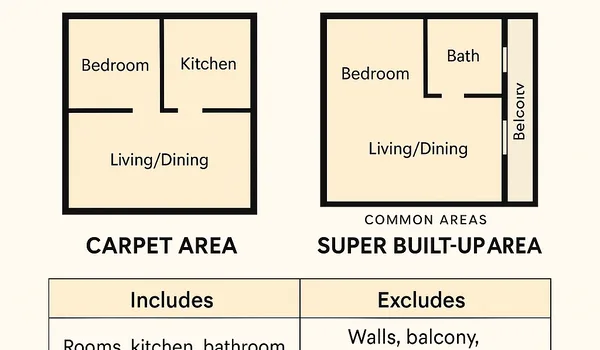
- Carpet area and super built-up area: the carpet area (RERA-defined usable area) and the super built-up area on which price is calculated. The difference between these two figures is the loading factor.
- Provisional price: the price per sq ft and total consideration based on the current price list. This is provisional until the agreement to sell is executed.
- Booking amount paid: the amount received from you, with the date. Keep this receipt separately.
- Reference to payment schedule: the allotment letter may reference the payment plan (time-linked or construction-linked) that will be detailed in the agreement to sell.
- Project RERA number or acknowledgement: for pre-launch projects, this may be the RERA application acknowledgement number. No RERA reference at all is a red flag.
The allotment letter is not a substitute for the agreement to sell. It does not commit the builder to a possession date, does not contain penalty clauses, and does not bind either party to RERA protections. It is the starting point, not the contract.
Agreement to Sell vs Builder Buyer Agreement - Key Differences
You will encounter two terms: Agreement to Sell (ATS) and Builder Buyer Agreement (BBA). They describe the same document - the formal contract between you and the promoter that governs the entire purchase from booking to possession. Some builders use one term, others use the other. What matters is the content, not the label.
The ATS/BBA is distinct from the final registered sale deed in the following ways:
- When it is signed: the agreement to sell is executed early in the purchase cycle - within the first few months after booking, and before any major payment beyond 10% of consideration. The sale deed is executed at the end, after OC.
- What it transfers: the agreement to sell does not transfer ownership. It creates a contractual right to purchase the flat on agreed terms. Ownership only transfers with the registered sale deed.
- Stamp duty: in Karnataka, stamp duty on an agreement to sell for a new project is nominal (confirm the current amount with your lawyer or the sub-registrar). The full stamp duty (5.6% of guidance value or consideration, whichever is higher) is paid at the time of the registered sale deed.
- Registration: under RERA, the agreement to sell must be registered at the sub-registrar office - not merely stamped. Verify this is done; an unregistered agreement has weaker legal standing.
- Governing law: the agreement to sell is governed by RERA, the Transfer of Property Act, and the Karnataka Apartment Ownership Act. RERA specifically mandates certain clauses that must appear in the agreement.
For the legal due diligence you should do before signing, see the things to check before buying guide.
RERA-Mandated Clauses in the Agreement to Sell
RERA (Real Estate Regulation and Development Act, 2016) mandates specific protections that must appear in every agreement to sell. The K-RERA portal publishes a model agreement format for Karnataka. Key mandatory elements include:
| Clause | What RERA Requires | What to Check |
|---|---|---|
| Unit of measurement | Carpet area must be the basis for price, not super built-up area | Confirm the carpet area figure matches the RERA-filed floor plans |
| Specifications | All declared specifications and amenities must be listed | Any item not listed cannot be enforced later; add what the sales team promised in writing |
| Possession date | A specific committed possession date is mandatory | Confirm the date matches what is filed on the K-RERA portal |
| Delayed possession penalty | Promoter must pay interest at the prescribed rate for each month of delay beyond the committed date | Check the penalty rate - standard RERA rate is SBI MCLR + 2%; negotiate upwards if the builder proposes a lower rate |
| Force majeure | A narrow definition covering events beyond reasonable control | Negotiate a cap on the force-majeure period (e.g., 12 months maximum); an open-ended force majeure clause effectively voids the delay penalty |
| Refund on cancellation | If the promoter cancels, full refund plus interest; if the buyer cancels, refund after deducting a cancellation charge | Check the cancellation charge percentage and the refund timeline (number of days) |
A builder's standard agreement may compress or weaken some of these clauses. Have a property lawyer compare the draft against the K-RERA model agreement. Deviations from the model that reduce your protection should be flagged and negotiated before signing.
To verify the project's RERA filing, check the K-RERA portal.
Payment Schedule and Construction-Linked Plan in the Agreement
RERA discourages purely time-linked payment plans (where payments are due on specific dates regardless of construction progress) and encourages construction-linked plans (where payments are triggered by completing defined construction milestones). A construction-linked plan protects buyers if construction stalls - your money moves only when work progresses.
A typical construction-linked payment schedule for a new Bengaluru project looks like this (percentages are indicative - confirm with your specific cost sheet):
| Stage | Typical % of Total | Notes |
|---|---|---|
| Booking / allotment | 5-10% | Paid from own funds before home loan disbursal |
| Agreement to sell execution | 10-15% | Typically triggers home loan first disbursal |
| Excavation / foundation | 10% | Bank inspects and certifies before releasing funds |
| Plinth / basement | 10% | Construction-linked tranche |
| Superstructure slabs (per floor) | 25-30% (across multiple tranches) | Largest disbursement phase; bank visits for each slab |
| Brick work / plaster | 10% | Construction-linked tranche |
| Flooring / finishing / fit-out | 10% | Near-completion tranche |
| OC and possession | 5-10% | Final payment; do not pay before OC is confirmed |
If your bank disbursing a home loan, it will do a site inspection before releasing each tranche. Pre-EMI (interest on disbursed amount) applies from the first disbursal; full EMI on the total loan typically begins at or after possession. Understand the pre-EMI-to-full-EMI transition in your home loan agreement.
What to Negotiate and Verify Before Signing
A builder's standard agreement is a starting document, not a final one. Before you sign, use a property lawyer to review and negotiate these points:
- Delayed possession penalty rate: the RERA-prescribed rate (SBI MCLR + 2%) is a minimum, not a ceiling. If the builder proposes a lower rate, push back. A higher penalty gives you real compensation if possession is delayed.
- Force majeure definition and cap: insist on a specific list of qualifying events (not a broad "circumstances beyond control") and a maximum period (e.g., 12 months total). An unlimited force-majeure provision effectively means the builder faces no penalty for delays.
- Specification downgrade compensation: if a specified material or fitting is unavailable, the builder must provide a written equivalent substitution or compensate you. Vague substitution language ("of equivalent quality") without a compensation mechanism is a risk.
- Exit and refund timeline: if you need to exit for any reason, when exactly is the refund paid? 30 days? 60 days? The agreement should specify a hard date, not "within a reasonable period."
- RERA number on the agreement: the RERA project registration number (or application acknowledgement for pre-launch) must appear on the signed agreement. An agreement without this cannot be linked to the RERA project record.
- Carpet area matches RERA filing: the carpet area in the agreement must match what the builder has filed with RERA. If it does not, the discrepancy must be resolved before signing.
- Lawyer review is non-negotiable: appoint your own property lawyer (not the builder's advocate) before the signing date. The builder's lawyer represents the builder's interests, not yours.
After signing the agreement to sell, the next major step is construction completion, OC and possession. For what happens at that stage, see the apartment possession and handover guide.
Allotment Letter and Agreement to Sell for Prestige Devanahalli
Prestige Devanahalli is a pre-launch project by Prestige Group, one of the most established residential developers in Bengaluru with a track record spanning decades and numerous delivered projects. For a pre-launch purchase, the RERA registration is in process at the time of booking. Key points for buyers at this stage:
- RERA acknowledgement: at the pre-launch stage, ask the builder for the RERA application acknowledgement number and verify that an application has been submitted on the K-RERA portal. Full RERA registration with a project number is granted after RERA review of the application.
- Allotment letter timing: the allotment letter is typically issued within a few days of the booking amount being cleared. Verify all unit details, especially the carpet area and configuration, before accepting.
- Agreement to sell: Prestige Group typically uses a detailed RERA-compliant agreement. Still, have your own lawyer review it - even with a reputable builder, protecting your rights through a documented review is standard practice.
- Possession timeline: Prestige Devanahalli has expected possession from December 2030. The agreement to sell should state this date and the applicable delayed possession penalty if the date is not met.
- Payment plan: see the Prestige Devanahalli price page for the current cost sheet and construction-linked payment plan structure.
- What comes next: after the agreement to sell, the next documents in the chain are the registered sale deed (after OC) and then the Khata and property registration in your name. For the full registration procedure, see the property registration process guide.
Frequently Asked Questions
1. What is an allotment letter in a new apartment purchase?
An allotment letter is the first formal document issued by the builder after you pay the booking amount; it confirms the allotted unit, block, floor, configuration, carpet area and provisional price, but does not transfer ownership and carries no legal charge on the land.
2. Is the agreement to sell the same as the sale deed?
No - the agreement to sell is a contract executed during construction that records the purchase terms, price, payment schedule and RERA-mandated commitments; the registered sale deed is the final ownership transfer document signed and registered at the sub-registrar after the builder obtains the Occupancy Certificate.
3. What must a RERA-compliant agreement to sell include?
A RERA-compliant agreement to sell must state the carpet area as the unit of measurement for price, list the declared specifications and amenities, set out a construction-linked payment schedule, specify the committed possession date, include a per-day delayed possession penalty clause, and define force-majeure conditions - confirm the mandatory clauses with your property lawyer.
4. Can I negotiate the builder's standard agreement to sell?
Yes - buyers commonly negotiate the delayed possession penalty rate, the force-majeure period, specification downgrade compensation, and the exit and refund timeline; have a property lawyer review the draft and flag any clause that limits or waives your statutory RERA rights before you sign.
5. What happens if the builder does not provide an agreement to sell after booking?
Under RERA, a promoter cannot accept more than 10% of the total consideration before executing and registering the agreement to sell; demanding further payments without a signed agreement is a RERA violation and you can raise a complaint on the K-RERA portal.
6. When should I get a lawyer to review the agreement to sell?
Always - engage your own property lawyer, not the builder's advocate, to review the draft agreement before signing; the lawyer should verify the land title, confirm RERA registration, check that all mandatory clauses are present and buyer-protective, and flag any clause that limits your rights.
Conclusion
The allotment letter and agreement to sell are the two documents that define your legal position from the day you book until the day you register the sale deed. Understanding what each document must contain, what RERA requires in the agreement, and what to negotiate gives you protection through the entire 4-5 year construction cycle in a pre-launch purchase.
Do not treat the builder's standard documents as fixed. Engage a property lawyer before signing the agreement to sell, verify the RERA filing, confirm the carpet area and possession date, and negotiate clauses that matter - especially the delay penalty and force-majeure cap. These steps cost a fraction of the apartment price but protect the full investment.
Prestige Devanahalli Blog